Forex Trading for Beginners
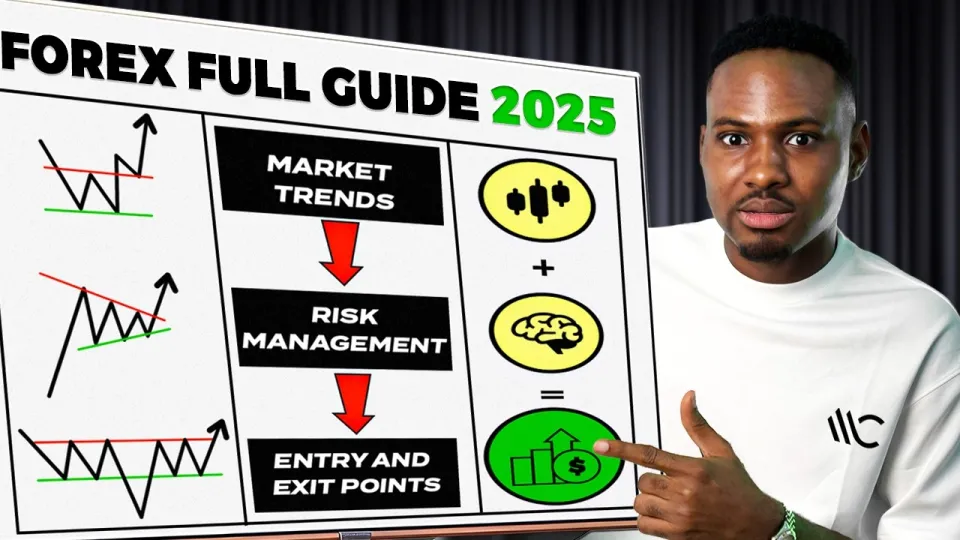
Video: How To Start Forex Trading For Beginners’ 2025 (Full Course)
Want articles like this for your own video to promote it on YouTube and Google? Order them through the Telegram bot @sat_sit_bot. The bot writes and publishes the articles itself (with your YouTube video embedded) on popular topical websites (no ads). Try it free: 50 articles on us.
· based on the channel Jeffrey Benson Forex
Key takeaways
- Forex is the global market for exchanging national currencies, with daily volume exceeding $7 trillion.
- Major sessions: Sydney, Tokyo, London, and New York; London-New York overlap offers highest liquidity.
- Essential tools: a regulated broker, MetaTrader 5 (MT5) platform, demo account, and economic calendar.
- Risk management: never risk more than 1-2% of account per trade; use stop-loss orders.
- Start with a demo account, practice a simple strategy, and keep a trading journal before going live.
Forex trading for beginners is the process of speculating on currency price movements to profit from exchange rate fluctuations. To start, you need a regulated broker, a trading platform like MetaTrader 5, a demo account for practice, and a clear risk management plan. For a structured learning path, consider the full course offered at Fire Pips FX plans, which covers everything from basics to live trading.
What Is Forex and How Does It Work
Forex, short for foreign exchange, is the global marketplace where national currencies are traded against each other. It is the world's largest financial market, with an average daily trading volume of over $7 trillion, according to the Bank for International Settlements. Unlike stock exchanges, forex has no central location; trading happens electronically over-the-counter (OTC) between banks, institutions, and retail traders.
Currency pairs are quoted in two parts: the base currency and the quote currency. For example, in EUR/USD, the euro is the base and the US dollar is the quote. A price of 1.1000 means 1 euro equals 1.10 US dollars. Traders profit by buying a currency pair when they expect the base currency to strengthen and selling when they expect it to weaken. The most traded pairs are the majors: EUR/USD, USD/JPY, GBP/USD, and USD/CHF. These pairs have the highest liquidity and lowest spreads, making them suitable for beginners.
Understanding Market Sessions and Liquidity
The forex market operates 24 hours a day, five days a week, across four major sessions: Sydney, Tokyo, London, and New York. Each session has its own characteristics. The Tokyo session (00:00–09:00 GMT) is typically quieter, with the JPY pairs showing more movement. The London session (08:00–17:00 GMT) is the largest, accounting for about 35% of daily trading volume. The New York session (13:00–22:00 GMT) overlaps with London for four hours, creating the highest liquidity and volatility window of the day.
For beginners, the London-New York overlap is often the best time to trade because spreads are tightest and price moves are more predictable. However, high liquidity also means faster moves, so risk management is crucial. Understanding session times helps you avoid trading during low-liquidity periods, such as the late New York session or holidays, when spreads widen and slippage can occur.
Tools You Need to Start Trading Forex
To begin forex trading, you need a few essential tools: a reliable broker, a trading platform, a demo account, and educational resources. Here's a step-by-step breakdown:
- Choose a regulated broker. Look for brokers regulated by authorities like the FCA (UK), ASIC (Australia), or CySEC (Cyprus). Regulation ensures fair practices and segregation of client funds. The video recommends Assex Markets; you can sign up via this broker link.
- Download a trading platform. MetaTrader 5 (MT5) is the industry standard, offering advanced charting, technical indicators, and automated trading. It's available for desktop, web, and mobile. After signing up with a broker, you'll receive login credentials to link your account to MT5.
- Open a demo account. Practice trading with virtual money before risking real capital. A demo account mirrors live market conditions and helps you test strategies without financial loss.
- Use an economic calendar. Tools like Forex Factory or Investing.com provide schedules of economic releases (e.g., interest rate decisions, GDP reports) that impact currency prices. Avoid trading during major news events unless you understand the risks.
- Keep a trading journal. Record each trade's entry and exit points, rationale, and outcome. This helps identify patterns and improve decision-making.
Additionally, consider joining a signal group for learning purposes. The video mentions a free daily signal channel: https://t.me/firepipsignals. For premium signals, there's a subscription bot: https://t.me/jeffreybenzhelpbot. However, always verify signals with your own analysis.
Basic Forex Strategy Foundation
A solid forex strategy is built on three pillars: technical analysis, fundamental analysis, and risk management. Beginners should focus on one simple strategy and master it before diversifying.
Technical analysis involves studying price charts to identify trends and patterns. Common tools include moving averages, support and resistance levels, and candlestick patterns. For example, a simple trend-following strategy might use a 50-period and 200-period moving average: buy when the 50 crosses above the 200 (golden cross), and sell when it crosses below (death cross).
Fundamental analysis examines economic indicators and news events. Interest rate decisions by central banks (like the Federal Reserve or European Central Bank) have the biggest impact on currencies. A rate hike typically strengthens a currency, while a cut weakens it. Keep an eye on inflation data (CPI), employment reports (NFP), and GDP growth.
Risk management is the most critical aspect. Never risk more than 1-2% of your account balance on a single trade. Use stop-loss orders to limit losses and take-profit orders to secure gains. For example, if you have a $1,000 account and risk 1%, your maximum loss per trade is $10. Position sizing calculators can help determine the correct lot size based on your risk tolerance.
Placing Your First Trade
Placing your first trade involves several steps: analyzing the market, setting entry and exit points, and executing the order. Here's a simple process:
- Analyze the chart. Choose a currency pair, such as EUR/USD, and identify the trend using moving averages or trendlines. Look for a clear direction: uptrend, downtrend, or sideways.
- Determine entry and exit points. For a long trade, enter at a support level or after a bullish signal (e.g., a bullish engulfing candlestick). Set a stop-loss below the recent swing low and a take-profit at a resistance level. Aim for a risk-reward ratio of at least 1:2 (risking $1 to make $2).
- Calculate position size. Use a position sizing formula: (Account balance × Risk %) / (Stop-loss distance × Pip value). For EUR/USD, one pip is typically $10 per standard lot. If your stop-loss is 20 pips away and you risk $10, your lot size should be 0.05 (mini lot).
- Execute the order. On MT5, open a new order window, select the pair, set the lot size, and input stop-loss and take-profit levels. Confirm the trade.
- Monitor and manage. Once in a trade, avoid emotional decisions. Let the trade hit your stop-loss or take-profit. If the market moves favorably, you can trail your stop-loss to lock in profits.
Practice this process on a demo account until you're consistently profitable over at least 50-100 trades before going live.
Common Mistakes to Avoid in Forex Trading
Many beginners make avoidable mistakes that lead to losses. Here are the most common ones and how to avoid them:
- Overtrading. Trading too frequently, especially during low-liquidity hours, increases costs and emotional fatigue. Stick to a set number of trades per day or week.
- Ignoring risk management. Not using stop-losses or risking too much per trade can wipe out your account quickly. Always define your risk before entering a trade.
- Revenge trading. After a loss, trying to win back money immediately often leads to bigger losses. Take a break and stick to your plan.
- Lack of a trading plan. Without clear entry and exit rules, you're gambling, not trading. Write down your strategy and follow it.
- Skipping the demo phase. Going live too soon with real money is a recipe for disaster. Practice on a demo account until you're confident.
- Not keeping a journal. Without recording trades, you can't learn from mistakes. A journal helps you identify strengths and weaknesses.
Frequently Asked Beginner Questions
Many beginners share similar concerns, as seen in the comments of the full course video. One common question is about the time needed to become profitable. The answer varies: with consistent practice and study, some traders see progress in 6-12 months, but it can take longer. Another frequent concern is the fear of losing money. This is normal; proper risk management and a demo account help build confidence. Viewers also ask about the best broker and platform. MT5 is widely recommended for its advanced features, and regulated brokers like Assex Markets are suggested. Finally, some wonder if they can trade part-time. Yes, forex trading can be done part-time, but it requires focused effort during chosen sessions.
Useful Links
- Fire Pips FX plans – structured courses and mentorship.
- Free daily signals – one free trade idea per day.
- Assex Markets registration – broker sign-up.
- Premium signals bot – subscription for premium signals.
Final Thoughts
Forex trading offers opportunities but requires discipline, education, and risk management. Start with a demo account, master a simple strategy, and gradually build confidence. The video course by Jeffrey Benson Forex provides a comprehensive foundation for beginners. For those ready to advance, consider the structured programs at Fire Pips FX plans to accelerate your learning. Remember, success in forex comes from consistent practice and continuous improvement.
Source: How To Start Forex Trading For Beginners’ 2025 (Full Course) · Markdown version
Questions & answers
How much money do I need to start forex trading?
You can start with as little as $100 with a micro account, but it's recommended to have at least $500-$1,000 to manage risk effectively. Many brokers offer accounts with no minimum deposit, but trading with too little capital increases the risk of rapid losses. Start with a demo account to practice without real money.
Can I trade forex part-time?
Yes, many traders trade part-time, focusing on specific sessions like the London-New York overlap. However, part-time trading requires a disciplined approach and a clear strategy. You don't need to watch the market all day; setting alerts and using pending orders can help.
What is the best strategy for beginners?
A simple trend-following strategy using moving averages and support/resistance levels is often recommended for beginners. Focus on one strategy, backtest it, and practice on a demo account until you achieve consistent results. Avoid complex strategies until you gain experience.
How long does it take to become profitable?
It varies, but with dedicated study and practice, many traders see progress within 6-12 months. Some take longer. Consistency, risk management, and learning from mistakes are key. Don't rush; focus on the process rather than quick profits.